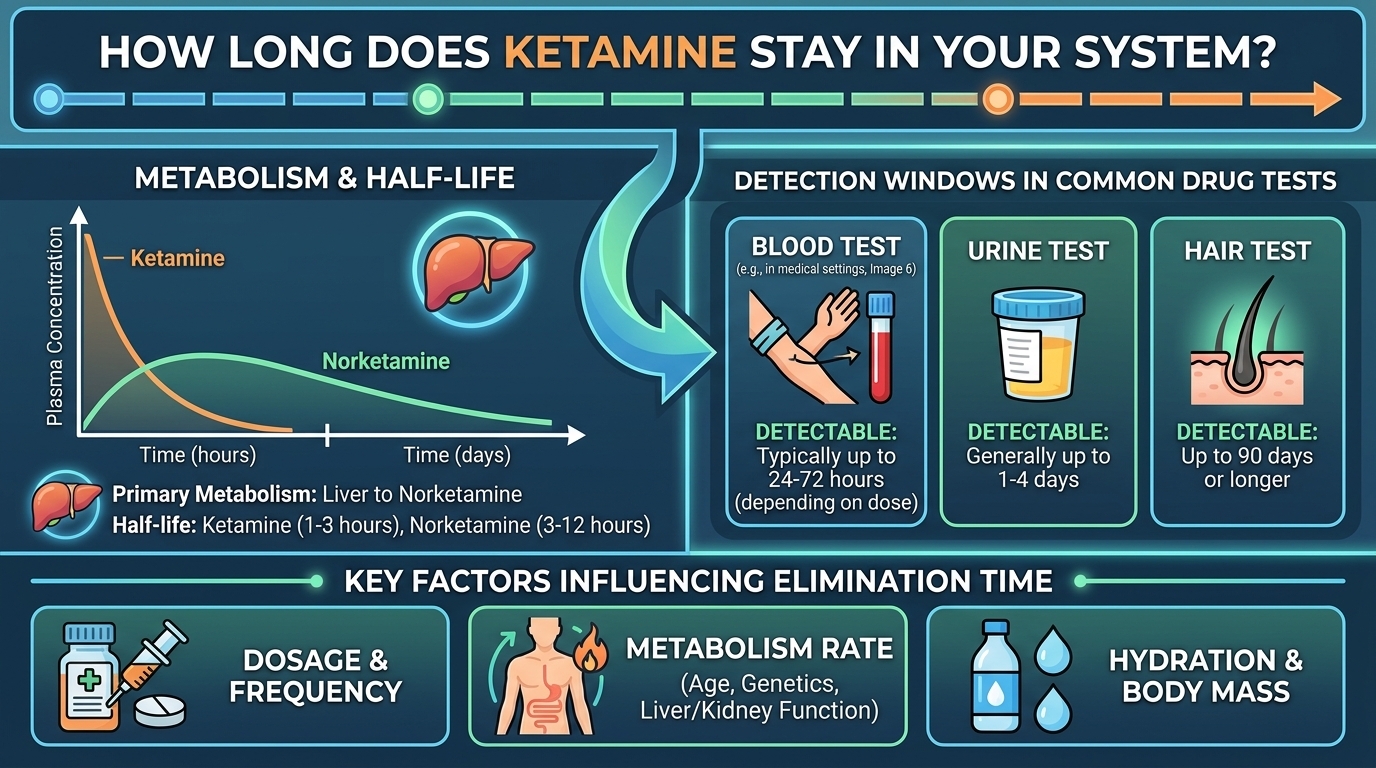
The answer to how long ketamine stays in your system depends on the person to whom you ask. This answer may vary from individual to individual. It also depends on what type of test is being used. Different tests of blood, urine, saliva and hair may yield different results.
Ketamine is rapidly eliminated from the blood. The body, however, transforms ketamine into other chemicals known as metabolites. Some of these may be detectable for longer. This can occur when someone is in withdrawal from ketamine, but still tests positive.
Why “Stay in Your System” Can Mean Different Things
People often ask the question of “how long does ketamine last in the body?”.There are different meanings to this question. One question some may ask is, “How long do they last?”. How a drug test detects ketamine could be a question on the minds of others. They are not synonymous.
Ketamine is metabolised during its use. The primary products are called norketamine. Tests can detect ketamine, the chemicals it is broken down into, or a combination of both.
Ketamine is also a relatively short half-life drug. This implies that the concentration in the blood drops relatively rapidly. But that does not imply that all of the tests will be negative on the same day. This can depend on the type of test, the quantity of the test and other individual factors.
Ketamine in Blood
There are other types of tests that can be done which have a longer window of detection compared to the blood test. This is because ketamine is rapidly distributed throughout the body and metabolized.
Ketamine can be quickly discontinued from the blood stream after it has been administered. Several factors determine the exact amount of time after which a blood test will be able to detect it. These include the amount taken, how it was given and the laboratory method used.
Don’t use a blood test as a definitive tool for determining the time of ketamine use. A test may indicate the presence of ketamine or related substances, but it won’t provide a precise time of use. In medicine or forensics, a blood test is performed more often when there is a reason to test for a substance.
Ketamine in Urine
One of the more common methods of drug testing is by using urine tests. Ketamine and its breakdown products may appear in the urine following the metabolism of the drug. Urine may be positive for ketamine or ketamine metabolites after the blood level has decreased. Urine tests can sometimes be positive when the symptoms are noticed to have been cured.
No one is the same in the detection period. This may vary with dosage, frequency of use of ketamine and test method.
Some tests are created to detect ketamine. Other lab tests are also performed to look for metabolites like norketamine. This can make a difference to the result. Therefore charts from online resources that provide one specific number of days should be approached with caution.
Ketamine in Saliva
Drug exposure can be detected in the past recent period with the help of a saliva test. It is not like urine testing, the drug entering into saliva is different. The time to detect saliva tests is usually shorter than that of hair tests. But this is not a time that fits for all.
Depending on the laboratory test that is being used, the outcome of the test may vary. The quantity of ketamine consumed and the interval between ketamine use and the time of collection of the sample may also be important.
In such cases a saliva test may be a valuable tool in determining the use of a recent period. However, it is unable to always determine the exact time of ketamine ingestion.
Ketamine in Hair
Hair testing works differently from blood, urine and saliva tests. Certain pharmaceuticals and their metabolites could be taken up by growing hair. This means a longer look back period may be available for hair. It may show exposure that happened weeks or months earlier, depending on the length of hair tested and the method used.
There are, however, some limitations in testing the patient’s hair. Everyone has a different rate of hair growth. Samples can be impacted by cosmetic treatments. The portion of the hair tested also can play a role.
Hair testing is not intended to determine the exact date or time that someone may have consumed Ketamine. It can serve as evidence of exposure for a longer duration but not as something that works like a simple calendar.
What Can Affect Detection Time?
Several factors may influence the duration of the detection of ketamine or its metabolites. One factor is how much is removed. If more, it may result in increased levels in your body. The frequency of use can also influence the outcomes.
How someone takes ketamine could also have an effect. The route of administration to receive medical ketamine could be different from non-medical use.
People also have different metabolisms when it comes to medicines and drugs. Medicines and health conditions other than those listed above can influence the way substances are metabolized.
Another key consideration is the test itself. The limits of different test vary. Some are more sensitive than others. All these differences mean that it is impossible to guarantee the detection time for anyone.
Detection Time Is Not the Same as Impairment
It’s worth to note that there’s a key distinction between the act of identifying and sustaining impairment. Sometimes a test is able to detect the presence of ketamine, or a metabolite of it, even after the effects of the drug have ceased. Just because someone said this does not automatically mean that they are feeling the same effects. There’s also the fact that the opposite can be crucial. Even at low levels of ketamine in the blood, a person can still feel confused, tired, or not feeling well.
This is the reason why a drug test should not be the sole basis used for determining safety to drive or engage in any task requiring full attention. If someone has taken ketamine and feels the effects, they should not drive or do anything where they or someone else may be at risk.
Medical Testing Versus Workplace or Forensic Testing
The context of a test result may influence its application to the situation. A test may be ordered by a doctor if there is a medical need for testing to look for a drug or possible exposure. The goal may be to learn what has occurred and to offer appropriate treatment.
There can be varying rules for workplace tests and forensic tests. They might employ certain cutoff values and lab techniques. There may also be a more comprehensive test that follows a screening test to be used to confirm a test result.
It is important that the person interpreting the test has a complete understanding of what type of test was performed and must interpret the positive test result accordingly. A workplace test and a specialist laboratory test may not always work the same way as a home test. Sample type is also important.
Key Takeaway
Ketamine leaves the blood relatively quickly, but its metabolites may remain detectable for longer periods. Detection times vary based on the type of test, dose, frequency of use, metabolism and laboratory methods. A positive test does not necessarily mean a person is still impaired, so test results should be understood in the right medical or testing context.
References
https://pmc.ncbi.nlm.nih.gov/articles/PMC6020109
https://pmc.ncbi.nlm.nih.gov/articles/PMC10995950
https://archive-ndarc.med.unsw.edu.au/sites/default/files/ndarc/resources/TR.120.PDF
Evidence last checked: 26 September 2026