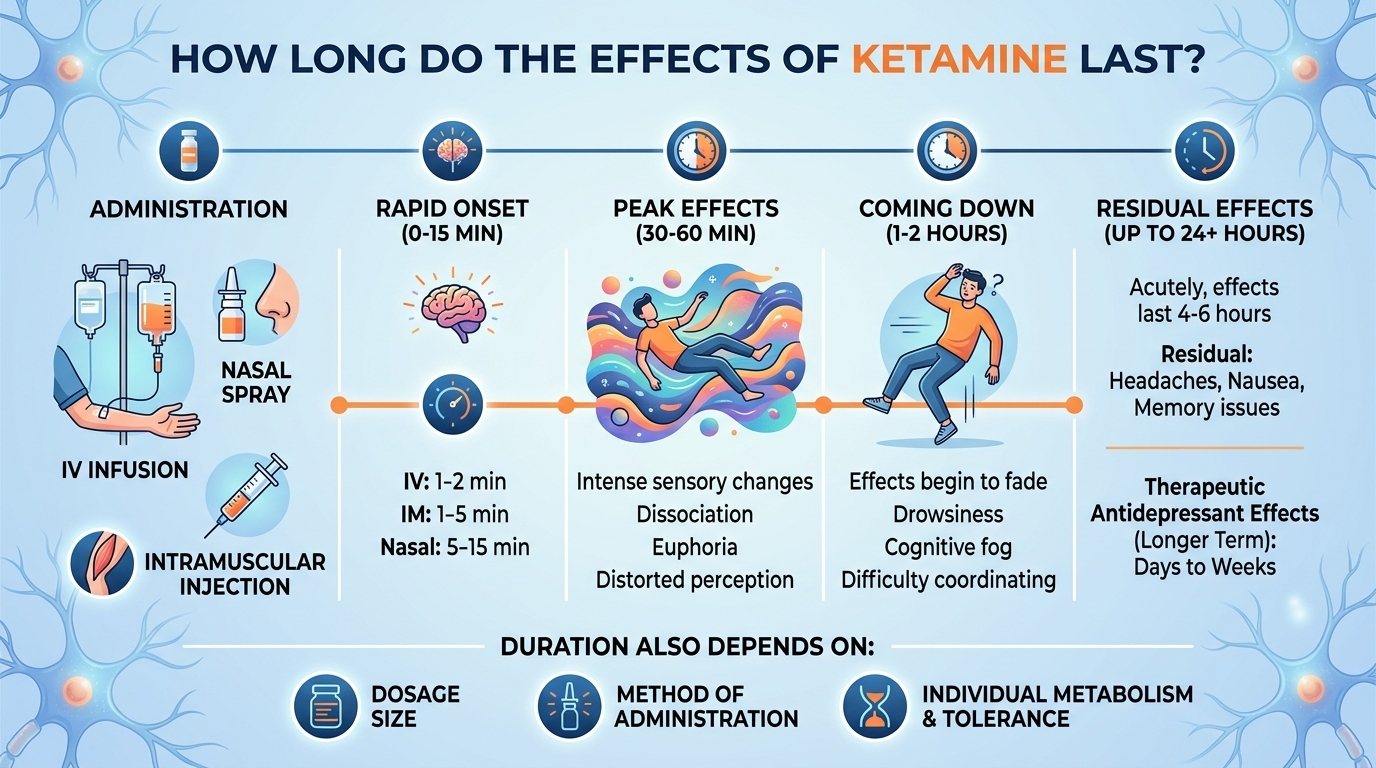
The time that Ketamine effects last will vary from person to person. The main effects go away rather quickly, however some might experience fatigue, confusion, dizziness or unsteadiness for a longer period of time. All of this may be different depending on the type of ketamine, how it is administered, how much is administered and the health status of the person.
Ketamine is administered in a controlled setting in medical care. A healthcare team will be able to monitor the corrections made during and after treatment. The strength and composition of the substance cannot be known if it is used without regulation—making the impact more difficult to determine.
Remember, it’s also not always good to feel better at the next moment until the effects are cleared. After the principal effects have worn off, some people may continue to experience a lack of coordination, fatigue or fluctuations of attention.
Why Does the Duration Vary?
The best time for everyone is not the same. Ketamine takes its effects on people in many ways. One variable is the amount that is being removed, but this is not the only variable.
How the ketamine is taken into the body also has an effect on it. The effects may start quite quickly and last long or have delayed onset and persistence. In some cases, the tolerance of a person can also be a factor. The Advisory Council on the Misuse of Drugs notes that short-term effects are related to dose, route of use and tolerance.
Many other drugs or substances are also capable of altering the situation. Combining products can make the results less predictable and could make products more likely to cause serious harm. This is the reason why it shouldn’t be taken as a rule that one person’s experience is the same as another.
Medical Administration Versus Unregulated Use
For medical purposes, ketamine is used as an anaesthetic and for pain relief. It also appears as a treatment for some cases of depression that affects those who are resistant to other treatments such as esketamine. If it’s being administered as a medical treatment, the dosage and administration techniques are regulated. Patients are also supervised by their trained employees.
This is very different from unregulated use. Where the strength is not known, that means for an unknown product. It is also possible that they don’t know what’s really inside.
Even if a medicine is used for medical purposes, it can have short-term effects. Common symptoms are feelings of detachment and illusion, with dizziness, nausea and tiredness. According to the NHS site, most of the side effects go away the day of the treatment, but individuals may react differently to the drug.
That’s important because if someone has a concerning reaction then medical staff can act if it happens in a setting where medical help is available.
What Are the Acute Effects?
Acute effects are effects that occur during or immediately after the use of ketamine. This can lead to a feeling out of place, vision and hearing problems, loss of balance, dizziness, and nausea and confusion. Sleepiness, difficulties with normal mobility may be experienced.
The effects will be stronger at higher concentrations. The person might be extremely disorientated or lose awareness of things. When considering acute effects, the UK government’s more recent review mentions a reduction in consciousness and hallucinations as well as prolonged sedation.
Their effects can give rise to unsafe conditions with everyday activities. Ketamine can lessen the perception of pain, which can lead a person to miss the signs of an injury, or judge distances accurately.
This is why it may be unsafe to drive or engage in tasks that require full attention when the effects are still lingering.
What About Residual Impairment?
The initial drug effect of ketamine can, in some cases, become less potent before someone returns to a state of normal functioning. The effects can persist after the greatest intensity has subsided, this is called residual impairment. But someone might still feel fatigued, faint or less alert. They may also have problems with balance or concentration.
It’s when they feel well and healthy, for instance, but aren’t as fast as they should be in their response when they do. They may also struggle with concentration and making clear judgements.
Medical services will take this into consideration. Patients are under supervision after treatment as the NHS website explains that those using esketamine may feel tired, dizzy etc. It’s very important because being normal is not necessarily being completely recovered.
Why Feeling “Normal” May Not Mean Full Recovery
The effect of ketamine on someone’s experience is not the same for all aspects. The sudden awareness changes can go first, the tiredness or lack of concentration can persist.
One may also experience the primary effects as distinct from another person witnessing them. They can feel awake but there may be evidence that they’re not.
The safest approach is not to use the end of the main “high” as a sign that every effect has stopped.
If symptoms persist or worsen or are unusual, medical advice might be required. Especially if the individual has consumed other substances and/or has a medical condition.
What Factors Can Affect How Long Ketamine Effects Last?
Ketamine’s effects can include an effect on length and strength because of several factors.
- Dose: The larger the amount the stronger and longer the effects will prevail and recovery will take time.
- Route: These variations on the route may have an impact on the onset of action and the clearance of ketamine from the body.
- Tolerance: People who use ketamine regularly can react differently than a non-ketamine user.
- Other substances: Alcohol, sedatives and other drugs can change the effects and increase the risk of harm.
- Health: A person’s general health and how their body processes medicines can also affect their response.
- Medical setting: In healthcare, the amount and timing of treatment are controlled. It also can be monitored by professionals.
These factors may be different from person to person, so there isn’t one, clear answer that can be given to everyone which will tell when they are fully back to normal.
When Should Prolonged Symptoms Get Medical Attention?
Most of the short-term effects should pass with time. But severe, unexpected or more persistent symptoms need not be overlooked.
If an individual becomes unconscious, is having a seizure, if there are severe breathing difficulties, or they cannot be easily aroused, urgent medical help is required. Urgent assessment is necessary for severe confusion or a significant change in awareness can also require urgent assessment.
Please dial 999 in the UK in case of serious illness after taking ketamine. Report to the Emergency Team as much information as possible about what was taken. It can help them to provide the appropriate care.
Speaking to the GP or another healthcare professional about persistent disturbances following repeated use of ketamine is key. Regular use of ketamine has been associated with significant bladder, urinary tract, liver and other health issues.
Key Takeaway
Ketamine’s main effects may wear off fairly quickly, but tiredness, dizziness, confusion or poor coordination can last longer. How long the effects last depends on factors such as dose, how it is taken, tolerance, other substances and overall health. Feeling normal does not always mean full recovery, so avoid driving until you are fully alert and steady.
References
https://www.gov.uk/government/publications/ketamine-an-updated-review-of-use-and-harms
https://www.cntw.nhs.uk/resources/esketamine-patient-information-leaflet
Evidence last checked: 26 September 2026