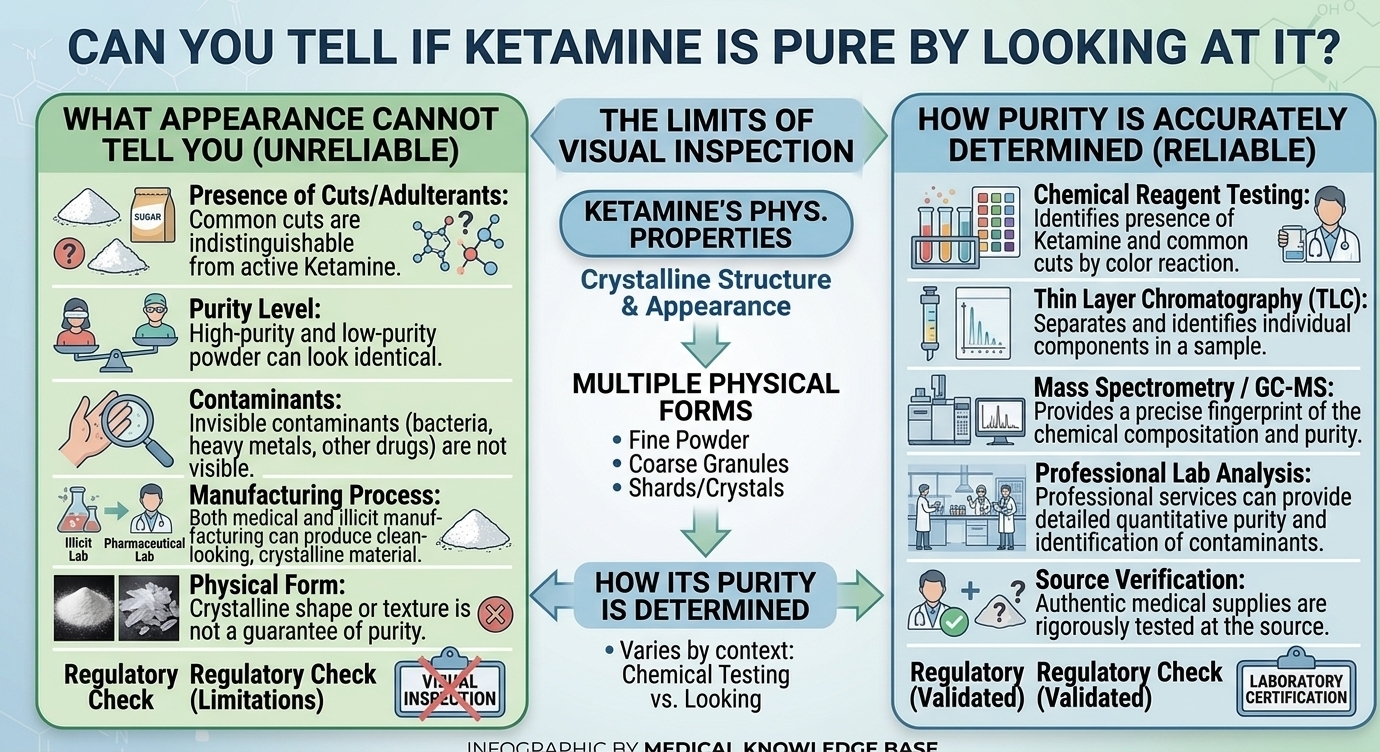
No, the purity of ketamine can’t be determined by looking at it. Colour, crystal size, powder texture, packaging and labels can be different; they cannot tell you what something contains or how much there is of ketamine.
Similar products may have different levels of purity or different drugs, according to the UK Advisory Council on the Misuse of Drugs (ACMD). It also specifies that drug content is not easily recognisable from the appearance of a drug.
It is important since the product that is purchased as ketamine may not contain or be as strong as the person expects. Independent laboratory analysis is not a certification or label issued by a seller.
Why appearance is unreliable
Sometimes powders and crystals can appear a lot alike, despite the distinction in their contents. For instance, a white powder is no specific enough to tell for sure what it is made of. The same goes for crystal visibility size or shape.
The ACMD’s 2026 review explains that ketamine powders can have a similar appearance to many other illicit drugs. It also notes that there are currently no field tests to help determine the contents of powders containing ketamine in such easy way.
That is not enough for a visual check to answer the questions most important. They cannot accurately inform you if a sample contains ketamine, what else might be contained or how much of the product contained.
Colour
It is not uncommon to use colour as a qualification to determine if a powder or crystal is considered healthy (normal). But purity has to be displayed except through colour.
A change in colour does not give a reliable measure of how much ketamine is present. Likewise, a product marked clean or uniform cannot be taken for granted to be a pure or uncontaminated supply of ketamine.
Differences in colour, smell, taste or consistency may be a good point for caution but it should not be viewed as the way in which it can be proven that the contents of a substance are different.
In the simplest terms, it can be a complex question that makes people wonder, but not give them an answer.
Crystal size
Another feature that could be misleading is, of course, the size of the crystal. There is no reliable reference to the size of the crystals for purity. The size of the crystals in an object may be influenced by the way the substance has formed, been treated or stored. It is not going to give a direct measurement of the chemical components.
This is why there is a difference between how something looks and what laboratory testing can show. The appearance of the sample may be similar, but there may be a few more or a few less of the substance expected. If a person sees a crystal it is impossible to be sure of its actual purity by looking at it.
Powder texture
There are other variations in texture that can be powdery. It can be fine, coarse, dry or tighter. These differences should not be assumed as an indicator of the strength or content of a sample.
The change in texture may be due to a number of causes such as storage or handling. It may also be caused by variations in what happens to one’s body. If the answer is not analysed correctly, it is impossible to say which explanation is correct.
The key is texture is a physical characteristic and not a purity test. The assumption that touch can be taken as an indicator of a substance can lead to misjudgements about the certainty of that substance.
This information should not be relied upon as means to determine the suitability or safety of an unknown powder.
Packaging
Packaging can give an impression of formality to the product, but packaging does not validate the product itself. You can place an unknown product that may be put into a labelled bag, container or bottle. It is possible to copy these or use it on a product that has not undergone independent checks.
It is also significant that there is a difference between a known medicine, provided through the regulated health care system, and an unknown product that has not been provided through that system. Licensed medicines meet standard quality controls, labelling requirements and have specific ingredients. Packaging provides context, however it cannot substitute for that of proper quality control or laboratory analysis.
Claims such as “99% pure”
Any statement of “99% pure” on a label or internet listing is not evidence enough. Without solid supporting evidence, the possibility of a purity percentage is meaningless. This may include suitable laboratory testing of a reputable source. This figure is not proven by the seller’s statement alone.
The ACMD has expressed concerns regarding inconsistent purity and sometimes misleading sales in street drugs. Also mentioned in the 2026 review is the data on some street-submitted samples that may have significantly varying purities.
This is why a number that is printed on packaging should never automatically be assumed to be a verified laboratory result.
Certificates and seller claims
Any certificate might seem like it’s valid, but you should ask questions about the source of the certificate and what is being verified. It may be possible to say that a sample has been analysed, but may not be possible to determine if that sample matches that in front of you. It could also not be known who analysed it, how it was analysed or whether it is up to date.
This does not mean every certificate is false. It refers to the fact that an unknown substance’s contents should not be automatically deemed to be confirmed by a certificate presented by a seller.
Medicines that are subject to regulation are dealt with within the medicines system, not relying on claims made by informal sellers.
Pharmaceutical products vs unknown substances
The medical ketamine is not a substance someone may have accidentally encountered or retrieved from a powder or crystal outside of the regulated medicine system.
UK medicines information lists ketamine products as prescription-only medicines. A licensed Ketamine injection would have a labeled active ingredient, known strength, a list of ingredients and controlled manufacturing data.
The electronic Medicines Compendium also provides clear specification of licensed ketamine injections for injection or infusion including information on composition and storage.
It is not sufficient evidence to say that a product cannot be identified at all if it is a ‘medical product’ which looks similar to a product found in the market. They are from completely different backgrounds.
Medical ketamine comes in the form of a controlled drug and can only be administered correctly in medical settings. If it looks similar, it might not be the same quality controls as an unknown substance.
Why certainty matters
Knowing what a substance contains is significant because the effects and risk of exposure may vary when you don’t know what is in it or how strong it is.
The ACMD’s current review highlights inconsistent purity and the possibility of mis-selling or adulteration in illicit drug markets. Similarly, it says that products that look like each other could have different drugs or different purity levels.
This makes visual judgement particularly limited. A person cannot simply look at powder and confidently provide information regarding its chemical make up, strength or safety.
Ketamine also has a legitimate medical use out there, but this does not mean that an unknown non-medical product is the same as a licensed medicine. Ketamine is still a controlled substance in the UK (Class B). In its review in January 2026, the ACMD advised that it should remain Class B.
The safest conclusion from the evidence is simple: appearance is not a reliable way to establish ketamine purity. The appearance in colour, crystal size, texture, packaging and the claims made by the seller may sometimes indicate how a product has been presented but these external attributes do not indicate what may be included.
References
https://www.gov.uk/government/publications/ketamine-an-updated-review-of-use-and-harms
https://www.gov.uk/government/news/acmd-announces-decision-on-the-classification-of-ketamine
Evidence last checked: 24 September 2026