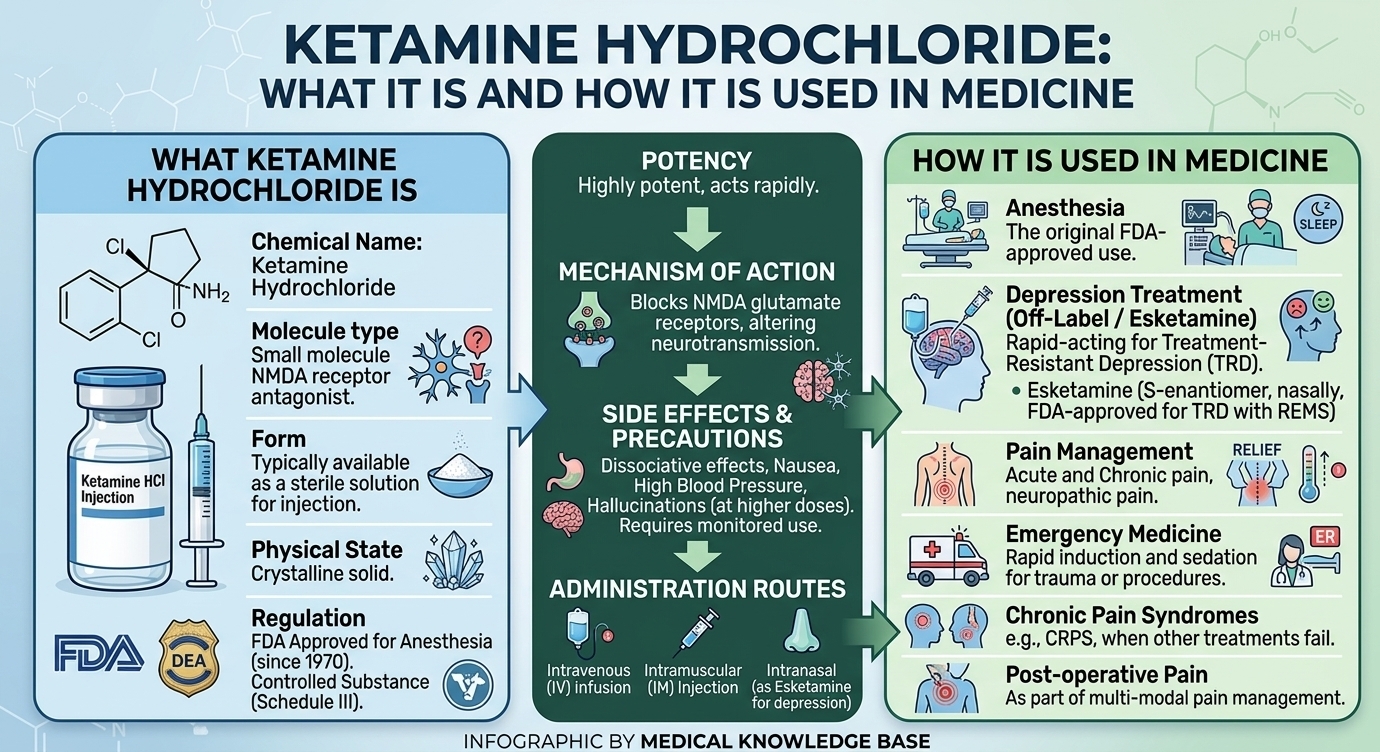
There are medicines containing ketamine in its chemical salt form, known as ketamine hydrochloride, in the UK. It is a salt derivative of ketamine, which helps provide a suitable pharmaceutical formulation in which the active component of the drug can be supplied.
The medicines containing ketamine hydrochloride sold in the UK are injectable medicines that are used in the healthcare setting, primarily for anaesthesia and, in some cases, pain management. The word “hydrochloride” does not mean that a medicine is stronger or more dangerous. It refers to the chemical compound of the drug. Knowing this difference will be valuable when reading the information on medicine labels or about ketamine.
What is ketamine hydrochloride?
Ketamine hydrochloride is the salt form of ketamine. The hydrochloride in simple terms, attaches to the molecule of ketamine so that the combination can be used in a pharmaceutical formulation.
This is not an uncommon scenario in medicine. Many active ingredients are given as salts, due to their chemical properties, and therefore are more suitable for a particular type of medicine. Therefore the label reference refers to the form of the active ingredient, and not another type of Ketamine as suggested by the name on the label.
Ketamine hydrochloride is an active ingredient of several medicines that are registered for use in the UK. For example, Ketamine injection is formulated into Ketamine hydrochloride, and is given as a clear solution for injection or infusion.
Why medicines are sometimes supplied as salts
The chemical properties of actual molecules of a drug may not be optimal for its administration on their own. A salt can make the substance more suitable for producing a stable medicine in a particular form.
This is not because salt is a completely different medication with entirely different effects. The active ingredient still has the desired pharmacological action via ketamine.
Many drugs work in a similar way. The specific salt chosen will be determined by the type of drug and formulation.
The active ingredient of ketamine is listed on its product information as Ketamine hydrochloride for the United Kingdom. Some product information gives a quantity of ketamine hydrochloride and describes the strength in terms of the amount of ketamine base.
Ketamine hydrochloride in UK medicines
Ketamine hydrochloride can be used in licensed UK injectable drugs. The electronic Medicines Compendium lists several products containing this active ingredient, including Ketalar and other ketamine injection products. These are prescription only medicines.
Product information makes it known that the product can be utilized as an anaesthetic for diagnostic and medical models. It can be given as a single agent or in combination with other anaesthetic drugs, depending on the clinical context.
This is not the same thing as an unregulated substance advertised online as “ketamine hydrochloride”. The chemical name used on a label is not an indicator whether a product is a licensed UK medicine or whether the components of the product are pharmaceutical quality.
Liquid pharmaceutical preparations
Ketamine hydrochloride is only available as a liquid, injected drug in UK clinical practice. The electronic Medicines Compendium states that medicines include such items as ketamine 10mg/mL Injections and ketamine 50mg/mL Injections, with the active ingredient listed as ketamine hydrochloride.
These products are made as medicines and have official product information about what goes into the product, how to use it, warnings and how to store it and any other safety information.
It is important to note that a liquid pharmaceutical preparation is different from a liquid preparation that is unknown and sold out of the regulated medical supply system. Nothing can be concluded about the composition of a substance or its production to pharmaceutical quality standards based merely on its appearance.
Clinical product information is designed to be used by health care professionals, and not as instructions for preparation or handling of ketamine other than in a health care facility.
Ketamine base vs ketamine hydrochloride
There is some potential for confusion when considering the terms “ketamine base” and “ketamine hydrochloride”, as both may be reported on the label of a medicine. The actual ketamine amount is called Ketamine base.
The salt form in the medicine is known as ketamine hydrochloride. The amounts of ketamine hydrochloride shown are not necessarily the same as the amounts of ketamine base, due to the extra chemical weight of the hydrochloride salt.
This is why, for instance, a medical product sold in the UK can say that every ml of the medicine contains a specific dose of ketamine hydrochloride equal to a specific dose of ketamine. This is the kind of language that is found on the product information sheet for a number of licensed injections.
To the patient, what matters are these numbers, part of the product information that is regulated. They cannot be used on unknown products for comparing and calculating.
Does hydrochloride mean stronger?
No. “Hydrochloride” does not indicate the ketamine will necessarily be stronger. It selects chemical salt forms of active ingredients. Strength is different and is dependent upon the concentration listed on the label, and the clinical use of the medicine.
For instance, there are multiple concentrations of ketamine injection in the UK. Although the active ingredient in their formulation is the hydrochloride salt, their product information explains the amount of ketamine base equivalent per millilitre.
It is also important not to compare an unregulated product with a licensed medicine simply because both use the words “ketamine hydrochloride”. Concentration, contents, quality, pharmaceutical status cannot be established from the name alone.
Does a label prove pharmaceutical origin?
No. A label containing the words “ketamine hydrochloride” is not enough to prove that a product came from a licensed pharmaceutical manufacturer.
Products that are legal in the UK are licensed. This includes details about the active ingredient, formulation, clinical uses, warnings and other requirements. The electronic Medicines Compendium contains details of some authorised drugs that contain ketamine.
Although chemical names may be used in an informal or unregulated label, it is not providing assurance. This is important because the wordings or the appearances on the packaging cannot guarantee the contents of a product by itself.
In the UK Ketamine is also classified as a controlled drug. In January 2026, the Advisory Council on the Misuse of Drugs recommended that it remain a Class B controlled substance after reviewing evidence on its harms and misuse.
Medical use in anaesthesia and pain care
Ketamine is used in anaesthesia. Product information details its use within diagnostic and surgical procedures for both adults and children in the UK. Can also be administered in suitable clinical situations for induction or as an additional anaesthetic medication.
Ketamine could also play a therapeutic role in pain management. NICE guidance on perioperative care says intravenous ketamine can be considered as a single dose during or immediately after surgery in certain circumstances, as part of postoperative pain management.
These medical uses are conducted in a clinical environment that allows the healthcare professionals to evaluate the medicine, patient’s condition and risks. They are not to be confused with unsupervised or unregulated use.
So to understand ‘ketamine hydrochloride’ primarily means understanding the chemical form of the medicine. It does not, by itself, tell you that a product is stronger, safer or pharmaceutical. The context and authorisation are also important.
References
https://www.medicines.org.uk/emc/product/6935/smpc
https://www.nice.org.uk/guidance/ng180
Evidence last checked: 22 September 2026